
FIBC Bags vs PP Woven Sacks: Which Is Right for Your Product?
Compare FIBC jumbo bags and PP woven sacks by capacity, handling, storage, distribution and cost to choose the right industrial packaging format.

Compare FIBC jumbo bags and PP woven sacks by capacity, handling, storage, distribution and cost to choose the right industrial packaging format.
When businesses start reviewing bulk packaging options, FIBC jumbo bags and PP woven sacks often appear in the same conversation. Both are made primarily from woven polypropylene, both are widely used for industrial products, and both can be customised to suit different applications.
But they are not interchangeable.
The difference is less about the material and more about how much product needs to be packed, how it will be handled, where it will be stored, and how it eventually reaches the end user.
A manufacturer moving one tonne of mineral powder through a forklift-led warehouse has very different packaging requirements from a company distributing the same product in 25 kg bags to individual dealers.
Understanding that difference early can prevent unnecessary packaging costs, handling inefficiencies and operational problems later.
Quick answer: FIBC jumbo bags are generally better suited to large-volume bulk movement and mechanical handling, while PP woven sacks are usually preferred when products need to be divided into smaller, individually manageable quantities.
An FIBC, or Flexible Intermediate Bulk Container, is a large woven polypropylene bag developed for handling bulk quantities of dry, flowable products.
You may also hear them called:
Jumbo bags
Bulk bags
Big bags
Tonne bags
Unlike a conventional sack, an FIBC generally includes lifting loops that allow the filled bag to be handled using forklifts, cranes or other mechanical equipment.
Depending on the application and specification, FIBCs are commonly used for products such as chemicals, minerals, fertilisers, grains, powders, construction materials and food ingredients.
They can also be engineered with different filling tops, discharge spouts, liners, baffles and safety characteristics.
That makes the FIBC less of a simple “large bag” and more of an industrial handling system built around the product being transported.
A PP woven sack uses woven polypropylene fabric to create a strong yet lightweight packaging format, usually intended for considerably smaller quantities.
Think of familiar 10 kg, 25 kg or 50 kg sacks used for products such as:
Rice
Flour
Sugar
Animal feed
Seeds
Fertilisers
Chemicals
Minerals
Construction materials
Depending on the product, the sack can be laminated, fitted with an inner PE liner, printed directly or converted into a BOPP laminated bag with high-quality graphics.
This means PP woven sacks can work across both industrial distribution and more brand-focused retail packaging.
So while an FIBC is largely about moving bulk material efficiently, the woven sack is often about breaking that bulk material into practical distribution units.
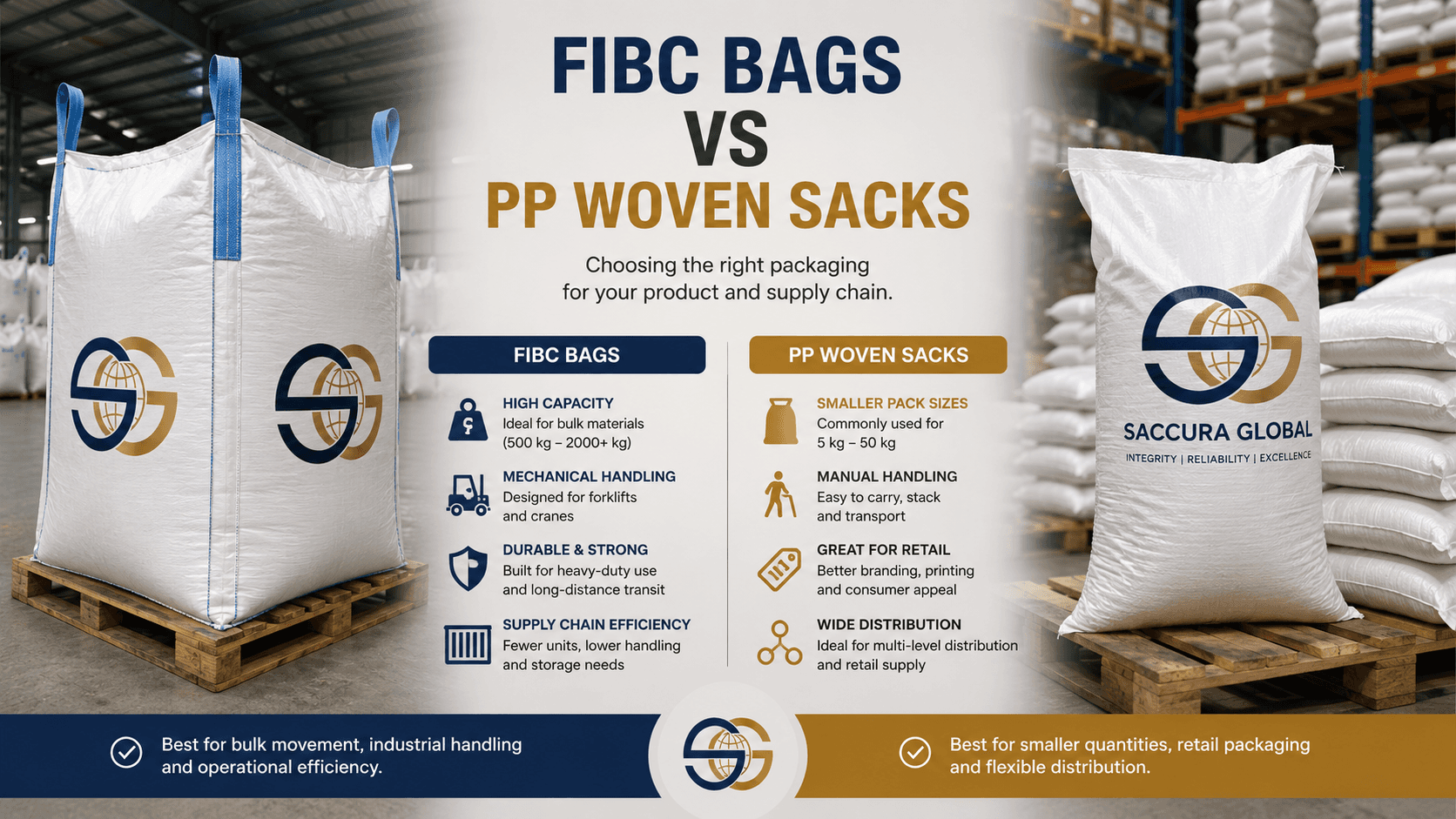
The easiest way to understand the two formats is to look at how they function throughout the supply chain.
Factor | FIBC Jumbo Bag | PP Woven Sack |
|---|---|---|
Typical use | Bulk movement | Smaller packaged quantities |
Handling | Mechanical handling | Manual or conveyor handling |
Lifting loops | Usually present | Generally not required |
Product quantity | Hundreds of kg to bulk loads | Often 5–50 kg |
Warehouse movement | Highly efficient for bulk material | Efficient for smaller units |
Distribution | Industrial/B2B | Industrial, dealer and retail |
Branding potential | Moderate | High, especially with BOPP |
Filling process | Bulk filling systems | Sack filling lines |
Best suited for | Large-scale material handling | Divided product distribution |
The important point is that neither option is inherently better.
The correct choice depends on what happens to your product after it leaves the filling line.
This is usually the first and clearest dividing line.
Suppose a manufacturer needs to move 20 tonnes of powdered material from its production facility to another industrial plant.
Packing that material into hundreds of smaller sacks could increase filling time, labour, loading effort and handling.
A suitably designed FIBC may allow the same material to be transported in much larger individual units.
Now imagine that the material is being sold through agricultural distributors who require each customer to purchase 25 kg at a time.
In that situation, the FIBC creates another problem: someone further down the supply chain still has to divide the product into smaller quantities.
The PP woven sack becomes much more practical.
If the product is moving as bulk material, start by evaluating an FIBC.
If the product is moving as individual saleable or manually handled units, start by evaluating PP woven sacks.
A packaging decision should never be separated from the equipment used around it.
FIBCs are designed for environments where mechanical lifting is available. Their lifting loops allow a filled bag to be picked up and moved using appropriate equipment.
PP woven sacks are more compatible with operations where individual bags are:
Manually lifted
Moved on conveyors
Stacked on pallets
Loaded individually
Distributed through dealers or retailers
This becomes particularly important when packaging is being sourced for a new facility.
A technically excellent FIBC can still be the wrong solution if the receiving warehouse has no equipment to handle it safely or efficiently.
Similarly, using hundreds of smaller sacks in a highly automated bulk-material environment may introduce unnecessary labour.
Packaging needs to work with the complete operating system, not simply contain the product.
Distribution strategy has a major influence on packaging selection.
An FIBC can be ideal when a material is moving:
Manufacturer → Industrial customer
A PP woven sack can be more appropriate when the route is:
Manufacturer → Distributor → Dealer → End customer
Why?
Because every additional distribution layer generally benefits from smaller and more manageable pack sizes.
A 1,000 kg package may be extremely efficient inside a factory but impractical inside a small agricultural store.
This is why packaging should be selected around the entire supply chain, not just the manufacturer's dispatch point.
Larger packaging formats can reduce the number of individual units moving through a warehouse.
That can mean:
Fewer packages to track
Faster loading
Reduced handling
Simplified inventory movement
Some FIBC designs, such as baffle bags, are also engineered to maintain a more stable square shape after filling, which can improve storage and container utilisation.
However, PP woven sacks offer flexibility of their own.
Smaller bags may be easier to:
Stack on conventional pallets
Separate by SKU
Move through smaller warehouses
Dispatch in partial quantities
Once again, the answer depends on the operation.
Warehouse efficiency isn't simply about fitting the most product into the least space. It is about making that product easy to receive, store, identify and dispatch.
The physical characteristics of the product matter just as much as weight.
A packaging specification may need to account for:
Fine powders
Dust generation
Moisture sensitivity
Contamination risk
Product flow
Static electricity
Food-contact requirements
Both FIBCs and PP woven sacks can be customised to address specific product requirements.
For example, a woven sack may incorporate a PE liner where additional moisture protection is needed.
An FIBC may similarly require a liner or specialised construction depending on the material.
This is why simply telling a supplier:
“I need a 1-tonne jumbo bag”
is rarely enough information.
A technically sound requirement should explain what is being packed, how much, how it is filled, how it is transported and how it is discharged.
This is one of the easiest mistakes to make during sourcing.
Suppose one packaging format costs significantly more per unit.
It can still create a lower overall cost if it reduces:
Filling labour
Loading time
Pallet requirements
Warehouse handling
Number of packaging units
Product losses
Transportation inefficiency
The right comparison is therefore not:
How much does each bag cost?
It is:
How much does it cost to pack, store, move and deliver the product using each packaging system?
BUYER CALLOUT
Compare packaging on total operational cost, not unit price alone.
A lower-cost bag can become an expensive packaging choice if it increases labour, product loss, freight requirements or handling time.
This is especially important for businesses purchasing packaging in large annual volumes.
An FIBC is typically worth evaluating when:
Large quantities are being moved per package
Forklifts or lifting equipment are already available
The receiving customer accepts bulk deliveries
Filling and discharge happen through bulk systems
Reducing the number of individual packages is important
Industrial efficiency is more important than retail presentation
For example, a chemical manufacturer supplying raw material directly to another factory may benefit from moving material in appropriately specified FIBCs instead of dozens of smaller sacks.
PP woven sacks are generally more practical when:
The product needs to be divided into smaller quantities
Individual bags will be manually handled
Products move through distributors or dealers
Retail or brand presentation matters
Multiple pack sizes are required
The end customer cannot handle bulk packaging
Agricultural products are a good example.
A fertiliser producer may manufacture huge quantities, but its customers may purchase one or two 50 kg bags at a time.
Here, smaller woven sacks make the distribution model possible.
Absolutely.
In fact, this is often overlooked.
Different stages of the supply chain may require different packaging formats.
A company might receive a raw material from its supplier in FIBCs, process that material internally, and then distribute the finished product in PP woven sacks.
Another company might use FIBCs for export customers buying industrial volumes while supplying domestic distributors in smaller woven bags.
So the decision does not necessarily have to be:
FIBC or PP woven sack?
It may instead be:
Where in our supply chain does each packaging format make the most sense?
That is a much more useful procurement question.
Whether you're buying FIBCs or woven sacks, a clearer RFQ usually results in better supplier comparisons.
Before approaching a packaging manufacturer, define at least:
Product being packed
What material will go inside the packaging?
Fill weight
How much product will each package carry?
Dimensions
What package size is required?
Material requirements
Are there specific fabric, GSM, lamination or liner requirements?
Filling process
How does the product enter the bag?
Discharge process
Particularly important for FIBCs.
Handling method
Manual, palletised, conveyor or forklift?
Storage conditions
Indoor, outdoor, humidity exposure or long storage periods?
Annual requirement
What quantities will actually be purchased?
Destination
Domestic and international supply chains can require different considerations.
Providing these details allows suppliers to quote against the real requirement rather than make assumptions.
The biggest mistake businesses can make is treating an FIBC and a PP woven sack as two versions of the same product.
They solve different operational problems.
FIBCs are generally designed around bulk handling efficiency.
PP woven sacks are generally designed around manageable distribution quantities.
The right choice comes from understanding:
Product + fill weight + filling system + warehouse + transport + customer handling.
Once these factors are defined, packaging selection becomes much clearer.
For businesses managing multiple products or markets, this evaluation can also reveal opportunities to use different formats at different points in the supply chain.
At Saccura Global, packaging sourcing begins with the application rather than simply selecting a product from a catalogue.
Understanding what is being packed, how it moves through the supply chain and what the buyer expects from the packaging helps create a more relevant sourcing specification.
This can include evaluating:
FIBC construction
PP woven sack specifications
Liners and lamination
Printing requirements
Bag dimensions
Supplier capabilities
Samples
Quality requirements
Commercial and logistics considerations
If you're deciding between bulk bags and PP woven sacks, sharing the product, fill weight, estimated quantity and destination is a good starting point for evaluating the right packaging route.
FIBC bags are primarily designed for moving large quantities of bulk material using mechanical handling, while PP woven sacks are typically used for smaller quantities that can be individually handled, distributed or sold.
They are designed for different load requirements. FIBCs are engineered to carry substantially larger loads and incorporate lifting systems, while PP woven sacks are designed for smaller individual pack weights.
The unit cost of the packaging alone does not provide a useful comparison because one FIBC may replace many smaller sacks. Buyers should compare total costs including filling, labour, storage, handling, freight and packaging requirements.
They are widely used for chemical products, but the FIBC specification must be appropriate for the specific material and its handling requirements. Certain applications may require specialised construction, liners or safety characteristics.
Yes. An internal liner can be incorporated where additional protection against moisture, contamination or product leakage is required.
Yes. Many businesses use different packaging formats at different stages of their supply chain. Bulk raw materials may arrive in FIBCs while finished products are distributed in smaller PP woven sacks.


